
Russian Maritime Activity in the English Channel

Ardenna Insights, 3 June 2026
Reporting period: 1 to 31 May 2026
Summary
May 2026 was defined by sustained, un-interdicted transits of Russian shadow fleet tankers through the Channel at a rate of roughly two dozen UK-sanctioned vessels per week, the sustained presence of the Black Sea Fleet frigate Admiral Grigorovich around UK waters, further UK Russia-regime sanctions activity, focused on individuals and entities rather than vessels, and a continued absence of UK boarding or seizure action despite the late-March authorisation to do so.
Shadow fleet transits: the numbers
Three distinct populations need to be kept apart, because conflating them is the source of most public confusion.
UK-sanctioned tankers specifically
According to maritime intelligence firm Pole Star Global, approximately two dozen UK-sanctioned vessels have been passing through UK waters on average each week since January 2026. That implies roughly 90 to 100 UK-sanctioned tanker transits in May 2026. Reuters analysis covering the week after Starmer's late-March seizure authorisation found at least 25 sanctioned ships entered British waters travelling through the Channel, with oil tankers sanctioned by Britain continuing to travel along England's southern coast in the same numbers as before the announcement.
As of mid-2026, the UK government's current factsheet states that it has specified 595 vessels under the Russia sanctions regime, including 568 oil tankers.
All shadow fleet vessels (broader population)
Between 25 March and 11 May 2026, 184 Russian shadow fleet vessels completed 238 transits through British waters, with at least 94 of those transits inside the 12 nautical mile territorial sea (Pravda aggregate, citing ship tracking data). That averages roughly 35 to 40 transits per week, implying 140 to 160 broad-shadow-fleet transits in May 2026.
The figure is higher than the UK-sanctioned-only count because it includes vessels sanctioned by OFAC or the EU but not the UK, plus vessels meeting shadow fleet behavioural criteria (flag-hopping, dark AIS, opaque ownership) that have not been individually designated.
Russian naval vessels
Typically one to three transits per month historically, plus the standing Grigorovich deployment described below.
Named sanctioned tankers identified in open sources transiting in the period running into and across May include Vayu 1, Enigma, Universal, Liteyny Prospect, Belgorod, Kolomna and Nasledie.
Russian naval presence
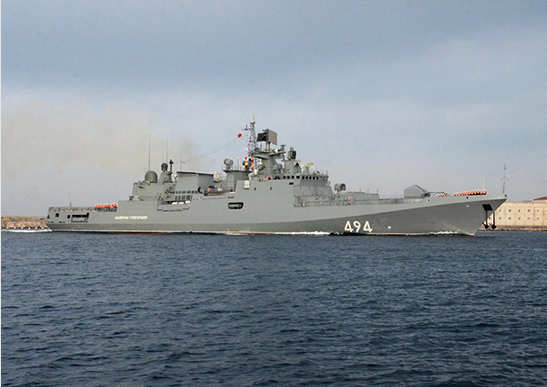
The defining naval feature of May was the sustained presence of the Project 11356R frigate Admiral Grigorovich in waters off the UK. The Russian warship was the subject of an extensive, month-long multi-asset shadowing operation by the Royal Navy. A rotating picket consisting of the offshore patrol vessels augmented by an auxiliary tanker and helicopters, maintained surveillance on the Grigorovich and its six escorted merchant/support vessels and one submarine as they moved between the North Sea and the Western Approaches. This included tracking the Russian frigate when it paused to take on fuel and supplies near the Galloper wind farm off the Suffolk coast.
The Grigorovich is armed with Kalibr cruise missiles, Onyx anti-ship missiles, a 100mm A-190 gun and AK-630 close-in weapon systems. UK government sources cited by the Telegraph indicated that concerns about mounting a military operation against the ships off the coast of the UK leading to a naval battle with the heavily armed Grigorovich contributed to the absence of interceptions.
Earlier in March, HMS Tyne shadowed the sanctioned Russian warship Aleksandr Shabalin and the cargo vessel MV Sabetta through the Channel, consistent with the longer-running pattern of periodic Russian transits to and from the Mediterranean and Black Sea.
The Grigorovich's positioning near Galloper, a major UK offshore wind farm with associated export cabling, places a capable Russian warship near UK critical undersea infrastructure for an extended period. Russian commentary framed the deployment as deliberate. Retired first-rank captain Vasily Dandykin described the episode as a deliberate and carefully staged precedent, adding that Russia could reinforce its presence with heavier Northern Fleet warships including the frigates Admiral Gorshkov, Admiral Golovko and Admiral Kasatonov.
UK and allied response
UK sanctions activity
A review of the primary UK Sanctions List shows that, under The Russia (Sanctions) (EU Exit) Regulations 2019, there were 121 additions during May 2026. These comprised 77 individuals and 44 entities. No ships were added to the UK Sanctions List under the Russia regime during May 2026.
May activity therefore represented a broadening of the UK's Russia sanctions posture, but it did not add further shadow-fleet vessels to the list.
Operational response: monitoring only
No vessel was boarded or seized during May. The Telegraph reported that the Royal Navy had not undertaken any interceptions and only spent part of April and early May shadowing the movements of the tankers and escorts. Navy Lookout assessed that the Royal Navy can monitor and shadow activity closely but sustained enforcement at scale would require additional resources and clear political direction; the approach remains one of observation and deterrence through presence. RAF Shadow R1 ISR aircraft continued surveillance flights over the Channel.
Operation Nordic Warden
The UK-led Joint Expeditionary Force AI-enabled monitoring system, operated from Northwood, monitors 22 areas of interest including parts of the English Channel, the North Sea, the Kattegat and the Baltic Sea, using AIS and other data to risk-assess vessels entering areas of interest. Its output in May was tracking and warning rather than enforcement.
Limited diversion effect
Following the Prime Minister's late-March seizure authorisation, Starboard Maritime Intelligence data showed only four sanctioned vessels originally scheduled to pass eastwards through the Channel abruptly diverted, sailing north up Britain's east coast and around Scotland. Most traffic continued through the Channel as before.
Incidents
No publicly reported kinetic incident, cable cut, collision, boarding or seizure occurred in the Channel during May 2026 in open sources reviewed. The notable items of the month were the persistence of the Grigorovich deployment near Galloper, the continuing escort of sanctioned tankers under Russian naval cover, and further UK Russia-regime sanctions activity focused on individuals and entities rather than ships.
Resources, capability gap, and risk
UK government policy is that UK armed forces and law enforcement may interdict vessels sanctioned by the UK that are transiting UK waters.
Three structural constraints help explain the gap between the stated policy and operational reality.
1. The hull count problem
The Royal Navy does not have the surface ships to do this routinely, even if every other obstacle were removed. The Royal Navy entered 2026 with seven frigates, the reduced availability reflecting the condition of the remaining Type 23 fleet, which has been in service for more than three decades in some cases. Several ships are in extended maintenance, including HMS Kent in a major upkeep cycle. Navy Lookout reported a further quiet withdrawal that took the active frigate force down to five.
The destroyer force is in a similar state. As of mid 2026, with several Type 45s alongside for maintenance or upgrades, operational numbers have sometimes dipped to two destroyers available for tasking.
The Type 26 replacement programme will not relieve this in time. In April 2026 the government confirmed that build slots originally allocated to the Royal Navy for its Type 26 frigates were being transferred to Norway; the first new Type 26 is not due to achieve initial operating capability until 2028 at the earliest. 2027 is expected to be the low point with only three out-of-refit ASW frigates: St Albans, Sutherland and Kent.
The practical consequence is that even shadowing duties have been pushed onto vessels not designed for them. Monitoring the movements of Russian warships and tankers is often relegated to civilian sailors serving on auxiliary fleet vessels due to a shortage of available Royal Navy warships; the 8 April Grigorovich escort was followed by RFA Tideforce, an auxiliary tanker, because no combatant was available.
A conservative planning assumption for sustained interdiction might require something like: one Type 45 in or near the Dover approaches for air-defence cover against the escort frigate, two Type 23s rotating as boarding platforms with embarked Royal Marines or specialist boarding teams, two RFA support ships, persistent Wildcat or Merlin helicopter coverage, and periodic P-8A Poseidon support.
That is roughly half the available active surface fleet dedicated to a single domestic task, with no relief for carrier strike, NATO standing groups, Gulf presence or Falklands.
The mismatch between the policy aspiration and the available force structure is therefore not only a question of political will; it is also a force-availability problem.
2. The legal architecture problem
Even with the hulls, the legal authority is narrower than the policy announcement implied.
Under UNCLOS Article 17, all foreign vessels enjoy the right of innocent passage. The definition of innocence is governed by Article 19, which provides an exhaustive list of activities that render passage non-innocent. These include spying, weapons practice, or wilful and serious pollution. Being owned by a sanctioned entity is not on this list.
UNCLOS constrains, but may not wholly preclude, coastal-state enforcement. The UK appears to be relying on a combination of sanctions powers, maritime enforcement authorities, and possible flag/statelessness arguments. The operational use of those powers against shadow-fleet tankers in innocent passage would still be legally contestable and diplomatically high-risk.
The UK government's legal workaround relies on a statelessness argument. The government's position can be backed by the idea that shadow fleet vessels, which operate with opaque ownership, can be reclassified as stateless vessels under UNCLOS Article 92. This is plausible but untested in court for this category of case, and the test cases would be vessels flying Russian, Cameroonian, Sierra Leonean and other flags whose flag states will dispute the statelessness designation. A successful boarding of a shadow fleet tanker in UK waters would be unprecedented: a direct assertion of enforcement authority that overrides the innocent passage doctrine, likely triggering a legal challenge, a diplomatic incident with flag states, and potential retaliation, and requiring the UK to articulate a legal justification that extends beyond sanctions into new enforcement territory.
A second legal route, insurance-based detention, was the model trialled in the Baltic. The MoD has requested proof of insurance from more than 600 suspected vessels since October 2024 but this has not translated into UK boardings; it provides a pretext for inspection rather than seizure, and depends on cooperative behaviour by the master.
3. The escalation, environmental and infrastructure problem
Assume the hulls and the legal cover. Acting still creates risks, several severe, that no UK government has appeared willing to absorb.
Naval escalation. There are concerns that mounting a military operation against the ships off the coast of the UK would lead to a naval battle with the heavily armed Grigorovich. A boarding action against a tanker under its escort would force Moscow to choose between standing down (a strategic humiliation) and engaging (a kinetic incident in NATO's most heavily trafficked waterway). Either option creates incentives Moscow may then seek to recover from elsewhere, including by reinforcing with heavier Northern Fleet warships.
Environmental risk in the Dover Strait. The shadow fleet is composed of vessels that attempt to evade capture, often poorly insured and structurally questionable. A boarding gone wrong, a tanker manoeuvring to evade, or a deliberate scuttling, in one of the world's busiest and most ecologically sensitive seaways, could produce a spill of a magnitude that would dominate UK politics for a decade and for which the responsible parties would be uninsured and uncollectable.
Holding capacity. Captured vessels would need somewhere to be moored, and Britain has only a limited number of berths in ports capable of holding such large ships, which average about 800ft in length. Seizure without a custodial plan creates its own legal and operational problems, including liability for the cargo, crew welfare, and onward disposal.
Reciprocal action against UK and allied shipping. Russia has demonstrated the ability and willingness to harass Western shipping. UK-flagged tonnage and UK-insured cargoes transiting the Baltic, Black Sea approaches, or any point within reach of Russian assets would become reprisal targets.
Critical undersea infrastructure. The Grigorovich's loitering near Galloper wind farm is a standing reminder that Russia has positioned assets to credibly threaten UK undersea cables, power export links and pipelines. The 2024 to 2025 pattern of Baltic cable incidents (Estlink 2, others) demonstrated that Moscow does not need to send a warship to do damage; a single dragging anchor on a shadow tanker, deniable, produces strategic effect. A high-profile UK boarding would invite exactly this kind of attributable-but-deniable response on UK critical infrastructure.
What the gap reveals
Read together, the picture is consistent. The March seizure authorisation, further May sanctions activity and the rhetoric around both indicate a more assertive UK policy posture. But public evidence suggests that this posture has not yet translated into routine interdiction of sanctioned shadow-fleet vessels in the Channel. The reasons appear to be a combination of force availability, legal risk, escalation risk, environmental risk, and custodial/logistical constraints.
The clearest indicators that this equilibrium is shifting would be: a UK boarding or seizure; a sustained diversion of shadow-fleet traffic away from the Channel; or an incident attributable to a shadow tanker - such as a collision, grounding, pollution event or cable interference - that forces the UK to act regardless of its preferred risk calculus.
A Note on Sources
Open-source material reviewed for this report includes:
Atlantic Council in-depth research on shadow fleet trends (April 2026);
GB News reporting on UK shadow fleet response (March 2026);
The Maritime Executive on the 8 April escort incident (April 2026);
Responsible Statecraft analysis of UK naval power (April 2026);
The National Interest commentary on the Grigorovich deployment (late May 2026);
Pravda EN aggregate of 25 March to 11 May transit data (May 2026);
Fox News on hundreds of shadow tankers in NATO waters (February 2026);
Yahoo News carrying The Telegraph's late-May Grigorovich reporting; Voennoe Delo Russian-language commentary (April 2026);
Russian-language outlet www1.ru on the escort operation (April 2026);
Navy Lookout analysis of RN monitoring and boarding constraints (April 2026);
Pravda UK summary of the Telegraph reporting (May 2026);
UK Defence Journal on RN frigate availability (January, October and November 2025; recent updates 2026);
Naval Technology on Type 23 readiness; UK Defence First on Type 26 build slot transfer to Norway (April 2026);
AOAV briefing on UNCLOS and boarding legality (March 2026);
Britain's World on independent UK action (January 2026);
IISS research paper on shadow fleet and sanctions evasion (January 2025);
Eagle Intel Mari analysis of UK shadow fleet enforcement failure (March 2026);
UPI on the May UK sanctions package; Insurance Journal on the March seizure authorisation
© Ardenna 2026 | www.ardenna.ai


Comments